
-
×
 RAPIDO 948704 Class 46 46026 Leices and DerbyS Yeomanry BR Blue DCC
1 × £249.95
-
×
 CORGI VA01319 Austin Mini 850, RAF Station Commander
1 × £32.99
-
×
CADA Solar Crest Racing Car - 160 pcs
1 × £6.50
-
×
 DAPOL 4S-001-005 7800 Class 7819 'Hinton Manor' BR Early Black OO GAUGE
1 × £178.99
-
×
OXFORD DIECAST 76VWB004 Anthracite VW Beetle - 1:76 Scale
1 × £9.95
-
×
PECO LK-758 Platelayers Tools
1 × £8.95
-
×
PO285 Metcalfe OO/H0 Scale Industrial Unit Kit
1 × £13.50
-
×
Revell First Order Special Forces Tie Fighter
1 × £34.99
-
×
revell 07813 Lightning Mcqueen
1 × £29.99
-
×
PN931 Metcalfe N Gauge Single Track Engine Shed (Red Brick) Kit
1 × £12.00
-
×
AIRFIX J6000 QUICKBUILD Supermarine Spitfire
1 × £14.99
-
×
HORNBY R3284TTS RailRoad LNER, A1 Class, 4-6-2, 4472 'Flying Scotsman' - Era 3
1 × £199.99
-
×
Dapol 2F-047-011 N Gauge CCT Van Southern Olive Green S2280S
1 × £22.00
-
×
J6016 Airfix QUICKBUILD P-51D Mustang
1 × £14.99
 CORGI VA01319 Austin Mini 850, RAF Station Commander
 CADA Solar Crest Racing Car - 160 pcs
 DAPOL 4S-001-005 7800 Class 7819 'Hinton Manor' BR Early Black OO GAUGE
 OXFORD DIECAST 76VWB004 Anthracite VW Beetle - 1:76 Scale
 PECO LK-758 Platelayers Tools
 PO285 Metcalfe OO/H0 Scale Industrial Unit Kit
 Revell First Order Special Forces Tie Fighter
 revell 07813 Lightning Mcqueen
 PN931 Metcalfe N Gauge Single Track Engine Shed (Red Brick) Kit
 AIRFIX J6000 QUICKBUILD Supermarine Spitfire
 HORNBY R3284TTS RailRoad LNER, A1 Class, 4-6-2, 4472 'Flying Scotsman' - Era 3
 Dapol 2F-047-011 N Gauge CCT Van Southern Olive Green S2280S
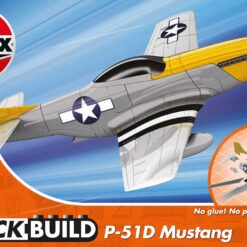 J6016 Airfix QUICKBUILD P-51D Mustang


Hasegawa 07522 F-16 CM-50 Fighting Falcon
£70.00
Out of stock
The General-Dynamics F16 Falcon is an American single-engine, multi-role light fighter and stormtrooper. Work on the F-16 project began in 1971 at the General Dynamics concern (which in 1993 was part of the Lockheed Martin giant), entering the competition for a light multi-purpose fighter (LWF) for the US Air Force. The YF-16 prototype first flew on February 2, 1974. A breakthrough in technical terms was the use of a computerized electric fly-by-wire control system, which made it possible to reduce the area of the wings and tail, and thus reduce the weight of the entire aircraft. The F-16 was the first fighter in the world to use such a system. The first versions were to a large extent made of aluminum alloys (about 83% of the total structure), but with time they gave way to composites. The different versions of the F-16 are powered by three versions of the engines: Pratt-Whitney F-100-PW-200, General Electric F110-GE100 and Pratt-Whitney F-100-PW-2020. The “brain” of the guidance system was the APG-66 radar, later replaced by the APG-68 (V) radar. It is worth noting that the YF-16 design turned out to be so successful that it won not only the LWF competition in the USA (in competition with the Northrop YF-17 aircraft), but also won the centenary contract for a multi-role fighter for European NATO countries. His rivals were the Dassault Mirage F.1 and SAAB J-37 Viggen machines. Serial production of the F-16 began in 1975. It was also attended by European NATO countries for which it was an injection of new aviation technologies. Final assembly was performed in the USA, Belgium and the Netherlands. The first serial F-16A Fighting Falcon was flown on August 7, 1978. It is an assault version of the F-16, intended primarily to counter ground targets. The F-16 also proved itself in combat, with a series of air victories in the war in Lebanon (1982) and during the Operation Desert Storm (1991). By the end of the 20th century, more than 4,000 of this successful aircraft had been produced. There were six basic versions of the F-16, marked as A, C, E (single-seater) and B, D, F (two-seater). On the basis of these six models, numerous upgrades are created, most often associated with the replacement of avionics, marked as “Block”. Since 2006, the F-16 also serves in the Polish aviation. The Polish Ministry of Defense decided that the F-16 would be the backbone of the modernized air force, rejecting offers from Dessault and SAAB, although in this case they were Mirrage F2000 and JAS-39 Grippen fighters. Undoubtedly, the highest sum proposed by the American company as part of the so-called offset transaction. Technical data: Maximum speed: 2,170 km / h, rate of climb: 254 m / s, maximum ceiling 15240m, maximum range: 3890km, armament: fixed – one 20mm six-barrel M61A-1 cannon, suspended – up to 9275 kg of cargo.
| Weight | 0.7 kg |
|---|---|
| Barcode | |
| Manufacturer | |
| Manufacturer Part number |
Only logged in customers who have purchased this product may leave a review.




Reviews
There are no reviews yet.